Flea and tick yard treatment in Gulfport, MS requires specialized chemistry formulated to endure coastal Mississippi precipitation cycles. Sandy loam soils throughout inland neighborhoods like Orange Grove, Landon, and…
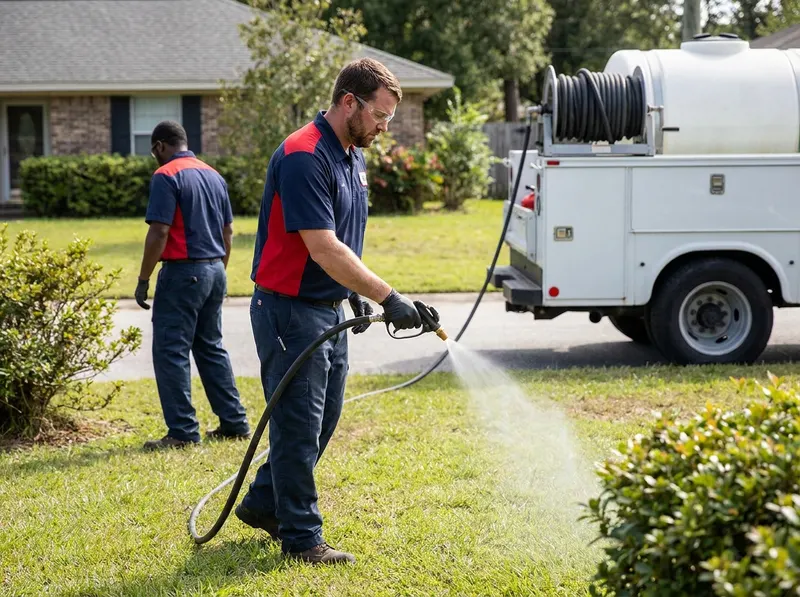
Flea and tick yard treatment in Gulfport, MS requires specialized chemistry formulated to endure coastal Mississippi precipitation cycles. Sandy loam soils throughout inland neighborhoods like Orange Grove, Landon, and Northwood Hills retain high sub-surface moisture beneath Bermuda and St. Augustine grasses, creating sheltered micro-habitats where flea pupae survive standard contact sprays. In mature coastal pockets such as Bayou View and Broadmoor, heavy tree canopies drop live oak leaf litter and pine straw that shelter deer mice and feral cats, continuously re-introducing lone star and brown dog ticks onto private grounds. Standard over-the-counter granules wash out quickly during heavy 60-inch annual rainfall events or break down under intense UV exposure near the coast. A professional barrier protocol addresses this vulnerability by deploying micro-encapsulated adulticides paired with juvenile hormone mimics that bind tightly to organic matter, stopping larval shedding without leaching into the surrounding watershed.
Treatment execution follows a deliberate perimeter-first pattern. Technicians clear the treatment zone, mapping shaded harborages, dog runs, and low-lying perimeter vegetation along boundaries shared with wooded ravines in Florence Gardens or drainage canals through Turkey Creek and Handsboro. Step one covers a continuous 3-foot vertical band up exterior foundation walls and 5 feet outward across adjacent mulch or turf. Step two applies a broad-spectrum turf residual using high-volume spray equipment that penetrates thatch layers where flea larvae feed on organic detritus. Step three injects targeted insect growth regulators beneath low-hanging shrubbery, crawlspace vent perimeters, and elevated porch skirts common to older properties in Soria City. For properties supporting large canine runs, choosing a dual adulticide and growth regulator application delivers 60 to 90 days of continuous interruption, whereas choosing an adulticide-only knockdown requires retreatments every 21 days due to unhatched pupal emergence; the trade-off is a slightly higher upfront investment versus repeated, disruptive monthly visits.
Property preparation dictates application efficacy. Homeowners must mow turf to a height of 2.5 to 3 inches 24 hours prior to service, collect yard toys, and clear fallen debris. Because water-activated insect growth regulators bind directly to dry soil and vegetation, irrigation systems must remain off for 24 hours post-application to permit the suspension to dry completely onto leaf surfaces. Animals and children must remain indoors until the liquid barrier dries entirely, which averages 2 hours under 85-degree Gulfport humidity. Veterinary flea control on resident domestic animals remains an essential parallel requirement: yard barriers prevent external re-infestation from perimeter wildlife corridors, but cannot cure untreated hosts inside the home.
Every job gets a firm, written price after a free on-site visit.
Tell us about your flea and tick yard treatment job in Gulfport and we'll send a clear, written quote, usually the same day.
 Lunexa Pest Defense