Formosan subterranean termites differ fundamentally from native subterranean species due to their colony sizes, which regularly surpass several million individuals per acre in the humid flatwoods of Harrison County. A…
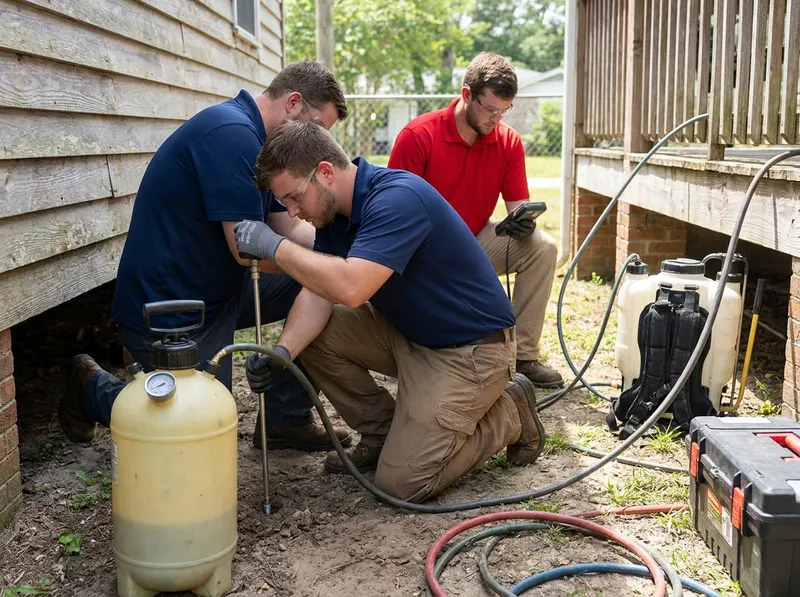
Formosan subterranean termites differ fundamentally from native subterranean species due to their colony sizes, which regularly surpass several million individuals per acre in the humid flatwoods of Harrison County. A native subterranean colony consumes roughly half a pound of wood per month, whereas a mature Formosan colony consumes up to a pound of structural wood every day. Traditional bait stations or simple perimeter dusting rarely stop an active Formosan attack because worker foraging lanes bypass surface poisons. Instead, effective defense demands a continuous chemical perimeter using non-repellent termiticides such as fipronil at a verified 0.06% to 0.125% dilution rate, pumped into trenches 6 inches wide and 6 inches deep around the entire perimeter foundation.
Slab construction common in Bayou View, Broadmoor, and Northwood Hills requires precision rotary drilling along interior expansion joints, garage slab seams, and plumbing penetrations every 12 inches to saturate the hidden soil layer below. In raised pier-and-beam properties throughout Soria City and Turkey Creek, high water tables and crawl space condensation create secondary moisture traps. Formosan colonies utilize this moisture to establish aerial carton nests, spongy structures made of masticated wood, soil, and saliva, within subfloors and wall framing without needing daily returns to exterior ground soil. Technicians identify these carton nests using thermal moisture meters before drilling structural framing to inject expanding dry foam termiticides directly into the nesting gallery.
Choosing remediation approaches involves balancing immediate perimeter disruption against interior structural access. Spot treatments or off-the-shelf repellant sprays merely scatter foraging workers into attic spaces and drywall framing, worsening hidden structural compromises. A comprehensive soil barrier coupled with foam injection treats the colony systemically, as foraging insects pass through the non-repellent barrier without detection, grooming one another and transferring the active agent to the queen. Treatment limits apply when crawl spaces hold standing water during heavy Gulf tidal or rain events; standing water must fully recede and soil moisture levels drop below 20% before liquid termiticide bonds properly with the soil bed. In neighborhoods like Florence Gardens, Orange Grove, and Landon, perimeter trenching stays minimally invasive, avoiding disruption to decorative concrete, while restoring structural stability to the home.
Every job gets a firm, written price after a free on-site visit.
Tell us about your formosan termite remediation job in Gulfport and we'll send a clear, written quote, usually the same day.
 Lunexa Pest Defense